AI: Genie Out of the Bottle or Pandora’s Box?

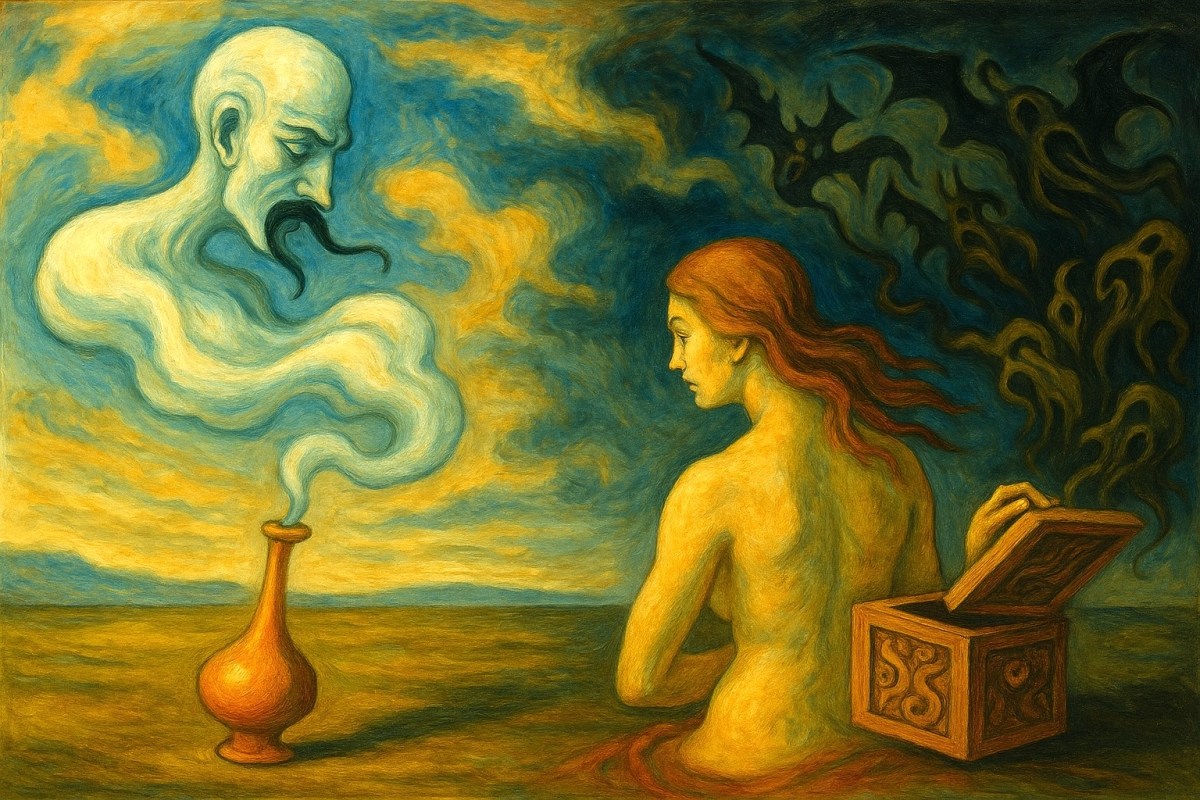
AI: What hath we done? Freed the Genie or opened Pandora’s Box?

Current sentiment around artificial intelligence is largely centred around loss. Lost employment. Lost control. Loss of the world as we knew it. Notice our cultural longing for 70s music, 80s TV shows and the seminal 90s when history was cleaved in two: the pre- and post-internet eras. Grunge music even marked the cultural inflection point.

Our sense of loss is driven by the chaos unleashed with the opening of AI’s Pandora’s Box. Chaos is, of course, the nature of change, and the rate of change fueled by AI is accelerating. Chaos isn’t inherently good or bad. It’s the process of creation. Chaos is the rawness of becoming. In Nature, the Creator guides the becoming. In our built world, tech bros guide the becoming. They took the wheel of the car while we blasted Nirvana, not noticing.

But AI is becoming what? The wish-granting Genie from the bottle or the flood of dark beasts springing from this freshly opened Box of Pandora? We’re already getting strong whiffs that it’s very much Pandora. At least with the Genie, we get what we wish for. With Pandora, we reap the whirlwind of opening the Box without knowing why.

It’s all stirring in the cauldron of our shared reality, and we’re not the ones doing the stirring. Representing nourishment for all, The Cauldron, actually known as Ting from the ancient Chinese tome the I Ching, suitably illustrates this situation in how it feeds and transforms, for good or bad. It depends on us.

As the I Ching counsels:

THE IMAGE
Fire over wood.
The image of THE CAULDRON.
Thus the superior man consolidates his fate
By making his position correct.
The I Ching or Book of Changes (Wilhem/Baynes)

In our shared cauldron, dystopian fears are dominating AI conversations in all expressions of current culture, from movies & TV to music, social media and news, of course, in all of its traditional and emerging forms, truthful or not. This is indeed a stew of fears, hopes and dreams, all wildly possible, and all very much out of our collective control. To be sure, we will seal our fate if we do not act out of ‘correct position’.
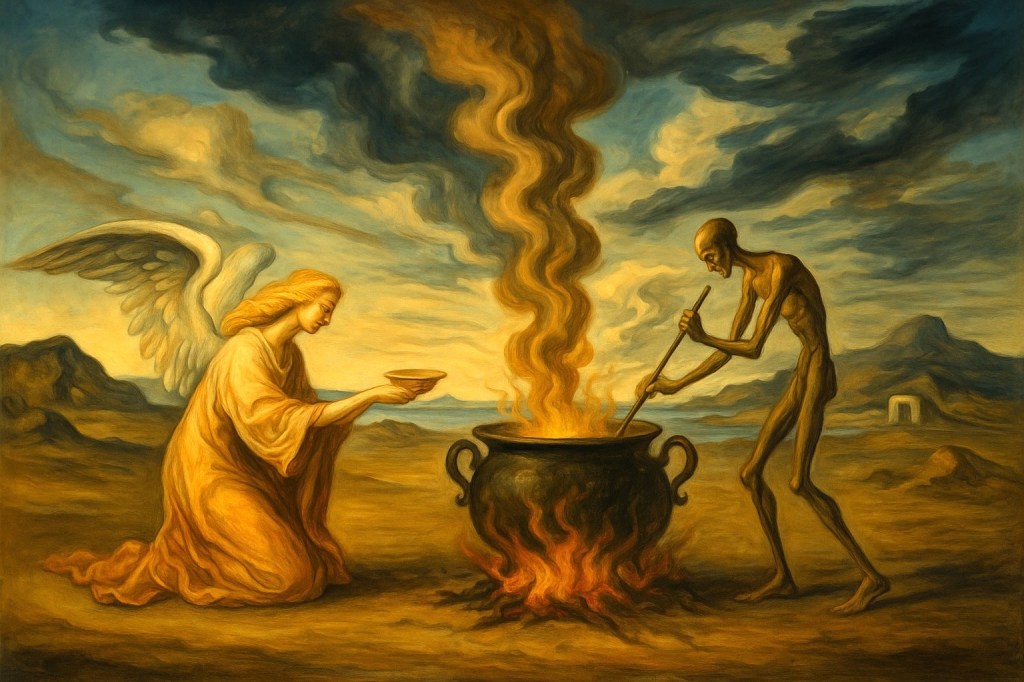
What wicked stew doth we brew? When it receives the Kiss of Divinity, will it be our doing or undoing?

So, what does correct position mean in the age of AI? It should mean alignment with truth, values and collective wellbeing.

But correct position is certainly not the case today, as this AI Cauldron is solely tended by the hands of technocrat billionaires. Our collective fate is set adrift in wildly oscillating forecasts of the future that regularly beach in the form of some tech CEO wearing a boom mic in front of a crowd, giving a speech or responding to planted questions in a forum or talk show. Every statement or sound bite often becomes headline news, boosting or crashing this or that stock. They’re all racing to win. And our hearts, souls and pocketbooks are the prize.

Those wishing to profit from the power and chaos unleashed by these tools are solopreneuring, or offering ‘consulting’ (in a space still governed more by hype than by clarity), or irrational doomsaying, all in a mob-like quest for more subscribers, more likes and more cash. This is very much like Jennifer Lawrence’s movie Don’t Look Up, but in this case, the comet is AI, and the expanding danger is unfolding every day, a slow-motion tsunami, while the hustlers are making a buck every which way they can.

The current dialogue could be summed up as this:

AI is simultaneously hailed as humanity’s greatest opportunity for abundance and innovation, feared as an existential threat to jobs and autonomy, and driven forward by powerful interests more invested in profit and control than in collective wellbeing.
~ironically yours, ChatGPT

The Cauldron is stirred by the wrong people for the wrong reasons. AI technology is being thrust upon humanity in the name of progress, but never before have we seen ‘progress’ (read disruption) on so many fronts, as our world careens ahead on a winding mountain highway with pretty much no guardrails.

Recall recent history; the arrival of the internet wasn’t permissioned. We weren’t asked if we wanted it. The internet just happened, quickly moving from an exciting but mysterious curiosity into a must-have resource for the modern world. Since then, it has infiltrated every aspect of our lives. We became addicted to it all.

Before our geese get cooked in the pot, we need to understand what meanings and impacts AI will have on us, not only this year but for the rest of our future history, so we can snatch the stirring spoon and put in our own ingredients. From correct position. Meaning humanity, not technocrats, manages the birth of this new era.

It’s kind of important. Entire livelihoods will be wiped out, or vastly changed, with systemic effects reverberating worldwide. Teenagers planning their post-secondary education are second-guessing everything now, trying to imagine what their contemplated career will be, or if it will even exist in the 5 to 10 years they have to complete their education. What meaning will money have when we mostly lose the ability to earn it? Solopreneurship is great, but not for everyone. Will we be saved by the rise of the zero marginal cost phenomenon? Universal basic income? Do you think any of that is on the radar of the current U.S. administration, or any other governments? Not.

They came for our attention in the 90s and monetized it to unprecedented heights. The most valuable companies in the world are testament to this fact. Now they’re coming for your jobs, your identities and your souls. If left unchecked, we will, forevermore, be fodder for their machines. The abattoir awaits us all.

So, the answer, of course, is we need to have our collective hands on the stick. The sooner the better. Because if we keep a hands-off approach, we will let AI happen to us, as it is now, rather than the other way around. We can’t put the Genie back in the bottle. We can’t close the box. But we can tend the Cauldron, with care, intention, and perhaps even love. And then we can have an intelligent conversation with the Genie about what our future will be.

The future is being stirred. Let’s not leave it in the wrong hands.

The next series of essays, foundational arguments for the Robot With a Thousand Faces publication, will explore both approaches to the Cauldron and how we may bridge the metaphors of the Genie and Pandora, if that’s even possible. From that place, we, as a human collective, can then become the activists for taking back control of AI and how it will impact us in the years to come.


Next in this series:

Choosing the Mythic Role to Live By

The Genie Out of the Bottle: AI as a Wish Granted

Pandora’s Box: AI as a Curse Unleashed

Bridging the Two Metaphors: a Fool’s Errand?
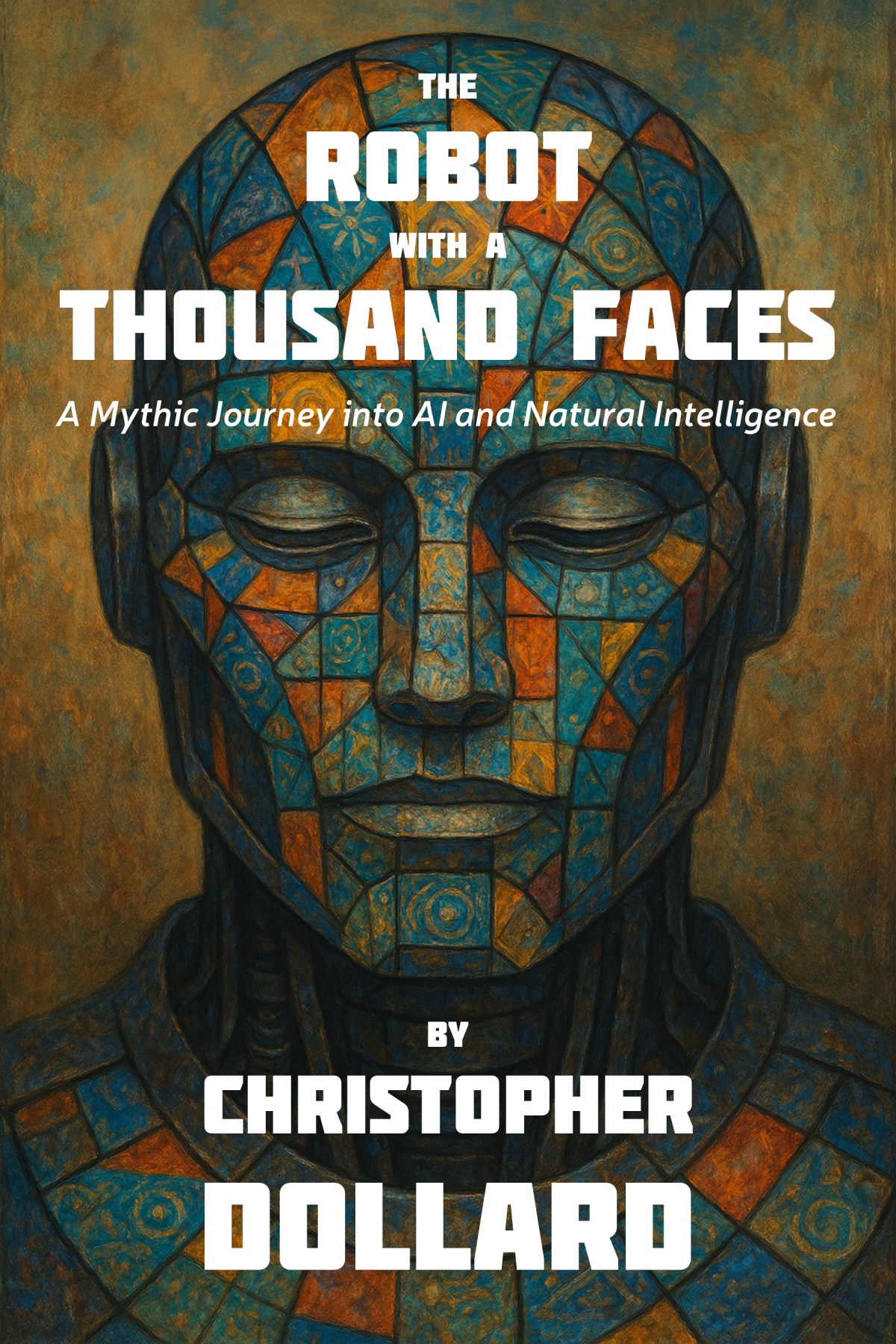
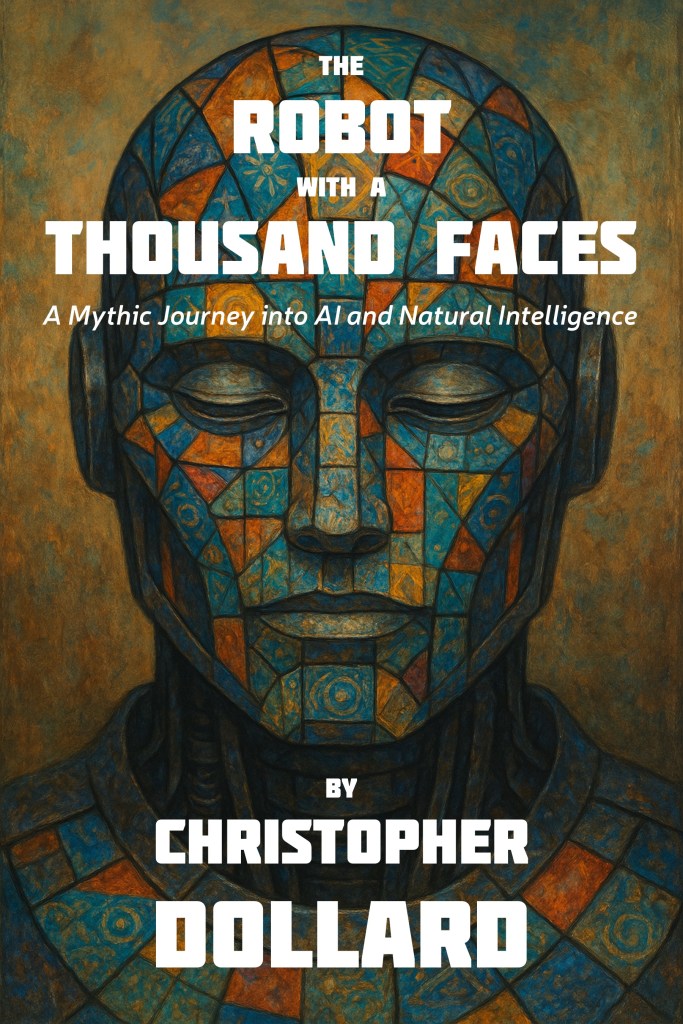
The Robot With a Thousand Faces

When I turned 31 years old in 1988 a switch flipped in my mind — my mother introduced me to the PBS series The Power of Myth with Joseph Campbell, interviewed by Bill Moyers.

Until that point, I went through the typical career moves. Studied business at the BC Institute of Technology. Worked in the family business. Looked for meaning in the creation of new companies. But something was missing. What’s the point of it all? Where’s the ‘magic’ in life? The synchronicities?

To say that I was gobsmacked by Campbell’s mythical frameworks for literature, film, and the human experience is an understatement. Within a year, I was cycling around Ireland with a dog-eared copy of The Hero With a Thousand Faces, exploring ancient sites, artworks, peering at the Book of Kells at Trinity College, and getting to know the famed Irish charm.

I’ve also loved technology my whole life, having come by it honestly through my Dad, Hugh, who was both a radio and audio engineer. I started coding PL/1 in 1978 at BCIT, and ended up as a software technical writer for many years after that.

But the Irish trip created a fork in my life’s road — one way a search for life’s meaning, and the other way a career pursuit in the technology space. Yet, like the famed Yogi Berra, I ended up not choosing either, but both. “When you come to a fork in the road, take it”. My interpretation, though, was not to choose one or the other to get to a destination, but both at the same time. The curse of a Gemini.

The Irish trip was also when I discovered another ‘presence’ with me during meditation. It was a tingle of energy that responded to my thought train, and helped me realize that I was on my own hero’s journey, expanding and investigating the art and history of the Celts in one of the richest examples in the world for a living Celtic society.

When I returned home to Vancouver in the late summer of 1989, it seemed that a dam had burst. All of these previously hidden thoughts and insights inside me were given flight in a Campbell-esque manner.

I met people who were into channelling their spirit guides. I followed suit and discovered inspirations and voices I never had before. My mum handed me a venerable copy of The I Ching or Book of Changes (by Wilhem Baynes, with foreword by Carl Jung), which I use to this day for advice on life matters. Within several years, I was sweat lodging, playing with Tarot, Medicine Cards and Runes for divination. From the Medicine Cards, I learned that my primary spirit animal is Lizard: sitting on a rock and dreaming of the future.

But I continued in earnest reading Campbell. Inner Reaches of Outer SpaceThe Hero with a Thousand Faces more times, and many other associated and adjacent writings.

Out of this process, I realized that society uses the word ‘myth’ in the opposite way it was intended. Mythologies are a culture’s stories, its moral compass, its history, its life lessons. Its truth. As a modern, ‘evidence-based’ culture, we have thrown out these dimensions of our mythological past in favour of the tangible instead of the intangible, the denotations instead of the connotations. We equate a myth with a lie. We have betrayed the sweep of our history with myth being a culture’s truths embodied in stories. This is one of our society’s most fundamental Achilles’ Heels.

We’ve perverted religion into face-value syllogisms that ignore the poetry of scripture. A poet doesn’t write ‘on the nose’. She writes to inflect rich meaning in the minds of her readers using metaphor, allegory and archetypes. We humans are symbolically fluent and emotionally driven creatures who have lost our way because our symbols are only one or two dimensions now. Our symbols feed our anxiety and our egos, not our souls.

A car can be beautiful and desirable, but the sacrifice to obtain that car can be immense, personally and collectively, and the experience of its possession dissolves into gnawing desire to have more beautiful objects, whether animate or inanimate.

Experiencing the artwork and rituals of the world’s great religions unlocks the cosmic truths about God and our place in the universe. It’s an unspoken but very real feeling. You don’t have to be Catholic to sit in the pews of the Notre-Dame Basilica of Montreal and feel transcendence. You do not have to ‘believe’ the words written in the bible. The words are not to be believed — that would be reductionist and barking up the wrong cosmic tree. The words are there to evoke meaning. Campbell talked a lot about this to his students at Sarah Lawrence College: people get hung up on the denotation of scripture, and completely miss the connotation. The universe of meaning behind the words can only be unlocked by human consciousness.

The essence of Campbell’s Journey can be defined as this:

“Joseph Campbell’s The Hero’s Journey outlines a universal narrative arc found in myths across cultures, describing the psychological and spiritual evolution of the protagonist. The journey begins with the Call to Adventure, where the hero is summoned from the ordinary world into the unknown. After initial Refusal and eventual Acceptance, the hero encounters Mentors, crosses the Threshold, and faces Trials and Challenges that test and transform them. At the heart of the journey lies the Ordeal, a confrontation with death or deep crisis that leads to a Revelation or Transformation. The hero then obtains the Elixir — wisdom, power, or insight — and returns to the ordinary world through the Return Threshold, often bringing back a gift or boon that benefits others. This cyclical structure reflects a path of growth, integration, and service — an inner metamorphosis mirrored by outer deeds.” (thanks ChatGPT)

Which brings me to the most daunting spectre of our time: the rise of artificial intelligence. Few topics have seared such a manic dystopian trauma in our collective consciousness, fuelled by movie hits like the Terminator series. Now our existential fears are metastasizing into the prospects of entire professions being wiped out within a few short years, with potentially legions of unemployed people rebelling and spreading anarchy.

But like any creature with the concept of ‘free will’ — meaning us, aliens aside — we have a choice. We can build ‘prepper’ walls around ourselves as we brace for the starving hordes and Mad Max-esque violence, or we can wrest control of the AI agenda from the billionaires hatching it for their own purposes.

So this introductory essay on the topic of what that can look like is really us looking in the mirror and embracing the technology to augment our consciousness, not to supplant it.

We’re going to examine how we can frame a technology movement into a mythic framework that is deeply ingrained in us: the Hero’s Journey. The specifics that Campbell has laid out mirror all of the greatest literature throughout history. We can use his heroic cycle scaffolding to guide us in how we gestate this new life we’ve created and nurture it to our overall benefit. Like any great story, the outcome is not assured, the path will have unknown twists and turns, and the cast of characters who will show up to build this new world is still undefined.

We can wrest the narrative away from doomsayers and the power elites by taking on this challenge, right now.

If you’re with me, please clap and follow and contribute!